

COVID19
7 MIN READ

Public health experts caution against hoarding inhalers and oxygen canisters and ask the public to refrain from self-medicating. Always consult a doctor before taking any drugs.

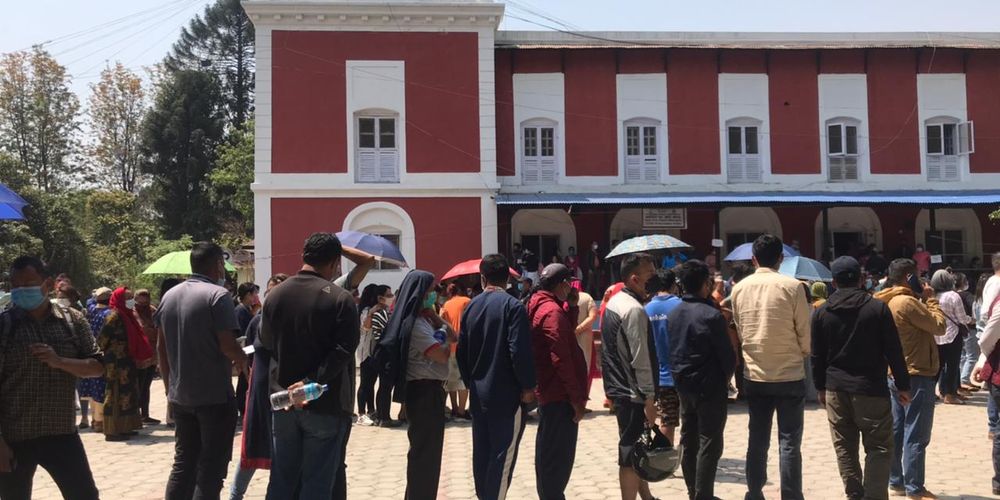
With the Kathmandu Valley going into a two-week lockdown on Thursday, many Nepalis are finally beginning to realize the gravity of the situation. Hospitals are filling up with Covid-19 patients and ICU beds are fast becoming scarce. Over the past few days, there has been a mad dash for vaccinations, resulting in hours-long queues at most hospitals and Valley residents are buying up oximeters, thermometers, and inhalers in order to prepare for the chaos that is likely to come.
Nepalis, primarily urban Nepalis, have been jolted out of complacency by reports emerging out of India, where hundreds of thousands are getting infected and thousands more dying every day. Hospitals have collapsed under the load and medical supplies — life-saving drugs and liquid oxygen — are in short supply.
In Nepal, daily Covid-19 cases are rising rapidly, from a few hundred two weeks ago to thousands today. On Wednesday, Nepal reported 4,774 new cases, bringing the total number of active cases to 312,699. 3,211 people have died so far.
The Valley’s three districts — Kathmandu, Lalitpur, and Bhaktapur — have instituted a 15-day lockdown, barring all non-essential movement and restricting all travel in and out. Schools, gyms, theaters — all of which had reopened after nearly a year of being closed — have been once again been forced to shut down. While these measures will help reduce the spread of the coronavirus, there are fears that the virus has already taken hold and will continue to spread in pockets. Nepal’s reproduction rate of the virus is 2.15, much higher than India’s 1.42, meaning that the virus is spreading much faster. Exactly a month ago, on March 28, the number of daily new infections was at just 89.
As the virus spreads, there is a very real possibility that Nepal’s fragile health care system will be quickly overwhelmed. Most of the Valley’s hospitals are either ill-equipped or already full, leaving the sick to fend for themselves. The scenario is similar in Nepalgunj, Dang, and Biratnagar. In order to prevent a situation like that in India, public health experts are asking Nepalis to not visit the hospital unless absolutely necessary.
In light of a number of image macros spreading on social media advising self-medication with drugs like dexamethasone, The Record spoke to a number of doctors, including virologist Dr Sher Bahadur Pun from the Sukraraj Tropical and Infectious Disease Hospital; Dr Achyut Raj Karki, the Covid-19 focal person at Bir Hospital, and Dr Sabin Thapaliya from Tribhuvan University Teaching Hospital’s Covid-19 committee member, to ascertain whether these drugs are safe to use without a doctor’s orders and what measures Covid-19 patients with mild symptoms can take at home to prevent an escalation.
First and foremost, doctors stress that precautionary measures like getting vaccinated, following social distancing protocols, and wearing masks are the best ways to keep the virus at bay and keep the infection rate at a manageable level. They also advise purchasing an oximeter and a thermometer, both of which should be available at local pharmacies. Oximeters measure oxygen saturation in the blood, which should generally be above 93 percent.
For those with mild symptoms like a fever, body aches, and cough, doctors advise staying home and medicating with paracetamol tablets. Home measures like consuming fluids and fortifying your immune system with antioxidant-rich food and fruits will definitely help. During this time, going into self-quarantine is key to limiting the spread of the virus. While this might be difficult while under lockdown, staying in one’s room, avoiding contact with other members of the household, not sharing utensils, and wearing masks at all times will greatly help prevent others from contracting Covid-19.
Home remedies like boiling guava leaves and drinking turmeric-ajwain (besar-jwano) concoctions can help boost immune systems but should not be relied on as a cure. Doctors also strongly advise against consuming gurjo (Tinospora cordifolia) in excess as it can cause low blood pressure and liver ailments.
If oxygen levels dip below 93 percent, breathing difficulties are likely to arise and patients will require immediate medical consultations. Many hospitals, including TU Teaching Hospital (01-410911) and BP Koirala Institute of Health Sciences (+977 9802794737), are offering consultations over the phone. The Ministry of Health also operates a number of Covid-19 hotlines [1133 (24 hours), 1115 (6 am - 10 pm), 977-9851255834, 977-9851255837 (8 am - 8 pm)].
If telephone consultations are unavailable, then patients should immediately visit the hospital. Do not attempt to self-medicate at this stage as miscalculations and self-prescriptions can be dangerous. Always consult with trained medical personnel before taking any drugs.
The Indian Ministry of Health recommends ‘proning’ when oxygen saturation levels dip below 94 percent. Proning is the process of turning a patient from their back onto their abdomen to ease breathing. It is a medically accepted method to assist those with breathing difficulties. However, it requires precise movements and must be accompanied by regular monitoring of oxygen concentration. Doctors in Nepal do not recommend proning without evaluating individual cases.
While some infographics and tip sheets circulating from India have recommended home use of budesonide inhalers or dexamethasone injections, doctors here in Nepal strongly caution against employing these medications without a doctor’s prescription. In India, doctors are recommending these methods in extreme cases where patients have been unable to get admitted to the hospital even when on the verge of death. Nepal is not at that stage yet and doctors do not recommend injecting drugs at home. Inhaler use should also not be generalized and should only be employed after a doctor considers individual cases. As inhalers can cause side effects, it is important that they are first prescribed by a medical professional.
Doctors also advise against hoarding oxygen cylinders as Nepal’s suppliers have said that they have adequate oxygen canisters in stock and will be able to meet demands. Hospitals have also stocked up on their supplies in the wake of the crisis in India.
The most important thing, say doctors, is to respect the lockdown, stay indoors, and avoid gatherings. Nepal is currently at a critical juncture and everyone needs to play their part in order to prevent the second wave from turning into a major insurmountable crisis. As the authorities have shown little interest in safeguarding public health, it is upto citizens to take precautions, exercise good judgment, and do everything in their power to prevent infections.
Covid-19 helplines:
1133 (24 hours)
1115 (6 am - 10 pm)
977-9851255834, 977-9851255837 (8 am - 8 pm)
Telemedicine consultations:
01-410911 (TU Teaching Hospital)
977-9802794737 (BP Koirala Institute of Health Sciences)
01-4100080, 01-4100052 (Ministry of Health and Population)
Dr Lochan Karki, Physician 977-9851076689
Dr Shiva Prasad Shrestha 977-9851057190
Dr Anil Bikram Karki 977-9804259283
Dr Badri Rizal 977-9851124899
Dr Prakash Budathoki 977-9841336943
For more info visit: covidnepal.org
For daily updates: covid19.mohp.gov.np
Graphics by Ishita Shahi

Record Nepal We are an independent digital publication based in Kathmandu, Nepal. Our stories examine politics, the economy, society, and culture. We look into events both current and past, offering depth, analysis, and perspective. Explore our features, explainers, long reads, multimedia stories, and podcasts. There’s something here for everyone.


COVID19
News
3 min read
Preventing coronavirus spread in Nepal’s overcrowded jails is becoming near impossible

Features
COVID19
4 min read
At 100,000 cases, the coronavirus pandemic in Nepal appears nowhere near ending

Features
5 min read
The earlier decision to provide festival perks to lawmakers—even as the pandemic continues to wreak havoc on the general populace—has been widely panned
COVID19
6 min read
Vaccinations should be a priority, say public health experts, but there aren’t enough doses in stock and a new supply is unlikely to arrive anytime soon.

Features
3 min read
As Nepal has only just started the procurement process, there is still no clarity on when the vaccines will arrive

Features
7 min read
With Nepal placed under the ‘red zone’ category by many countries, hundreds of students admitted to foreign universities are worried that they will lose their scholarships and an opportunity of a lifetime.

Explainers
Perspectives
7 min read
In choosing political expediency over the pandemic, Prime Minister Oli and President Bhandari have doomed many more citizens to death.


